





Local SEO for small businesses comes down to six things: a complete Google Business Profile, a page for each service and location, steady reviews, consistent business info, a few local links, and tracking that shows real leads. Do those well and your business has a better chance of showing up when nearby people search for what you sell.
This guide is the how-to. If you want the basics first, read what local SEO is and why it matters. If you are ready to build, start below.
Where Local Customers Find You
People with a local need rarely search for a brand name. They type things like “emergency plumber near me” or “dentist in Austin.” Your business can show up in three places:
- The map pack. The three businesses Google shows on a map above the regular results. For local service searches, it is the most visible spot.
- Google Maps. Searches made inside the Maps app, often by people already on the move.
- Regular results. Your website pages, ranked like any other search result.
AI answer tools like ChatGPT and Google’s AI Overviews also name local businesses now. They pull from the same signals: your profile, your website, and what customers say about you. We cover that in our SEO, local and AI visibility service.
Step 1: Set Up Your Google Business Profile
Your Google Business Profile (GBP) is the listing that appears in the map pack. It is usually the highest-impact place to start.
Google explains how it ranks local results in its own help guide.
- Claim and verify the profile.
- Pick the most accurate primary category. It is one of the strongest relevance signals.
- Add every service you offer, with a short description for each.
- Set your service area or address correctly. If customers do not visit you, hide the address and list the areas you serve.
- Use the same business name, phone number, and hours that appear on your website.
- Add real photos of your work, your team, and your location.
- Post updates and answer questions on the profile when you can.
Step 2: Build a Page for Each Service and Location
Google needs to know what you do and where you do it. One “Services” page that lists everything rarely does that well. Local SEO for small business sites works best when each page matches one real search.
Give each main service its own page. If you serve more than one city or area, add a page for each one you can realistically compete in, written for that place. A page for “water heater repair in Mesa” should mention the neighborhoods, the problems customers there have, and the jobs you have done nearby.
Each page should have:
- A clear headline that names the service and the area
- A short explanation of how the work is done and what it costs or what affects the price
- Proof: photos, reviews, certifications, or a short example job
- Your phone number and a simple form, easy to find on mobile
- A link to your Google Business Profile or map
Do not copy the same page and swap the city name. Google treats that as thin content, and customers can tell.
Step 3: Collect Reviews on a Schedule
Reviews affect both rankings and whether someone picks you once you appear. Treat them as a process, not a favor.
- Ask every happy customer, right after the job is done.
- Send the direct review link by text. It takes them one tap.
- Reply to every review, good or bad, in a calm and specific way.
- Never buy reviews or offer rewards for them. Google can remove them, and it can penalize the profile.
A steady stream of recent reviews matters more than a burst followed by months of silence.
Step 4: Keep Your Business Info Consistent
A citation is a mention of your business name, address, and phone number on another site, such as Yelp, the Better Business Bureau, or an industry directory. Google compares them to confirm your business is real and your details are right.
Start with the major directories and the ones specific to your trade. Make sure your name, address, phone number, and website match everywhere. Fix old addresses and old phone numbers first, since those cause the most confusion.
Step 5: Earn Local Links and Mentions
Links from other websites signal that your business is trusted in your area. You do not need hundreds. A few good local ones help:
- Your chamber of commerce or local business association
- Suppliers, manufacturers, or partners that list their installers or dealers
- Local sponsorships, charity events, and school or sports teams
- Local news or community blogs when you have something worth covering
Ask yourself whether a real person in your area would find the link useful. If the answer is no, skip it.
Step 6: Track Calls and Leads, Not Just Rankings
A first-page ranking does not pay the bills. Calls, form fills, and booked jobs do. Good local SEO for small business owners is measured by leads, not rankings.
Set up the following so you can see what is working:
- Google Business Profile insights for calls, direction requests, and website clicks
- Google Analytics and Google Search Console for your website
- A tracking phone number or a call tracker on your site
- A simple note of where each new customer says they found you
Look at these monthly. If rankings go up but leads do not, the problem is usually the page or the profile, not the ranking.
A 90-Day Local SEO Plan for Small Business
If you are starting from scratch, this order works well for most small businesses.
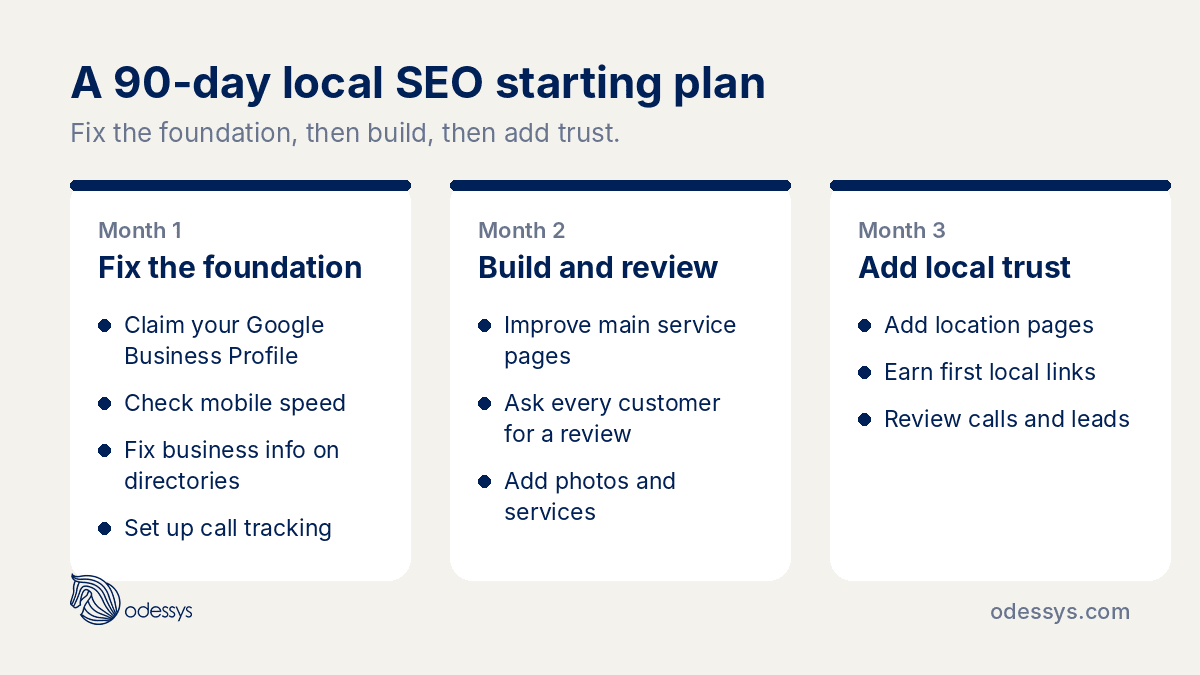
Month 1: Fix the foundation
- Claim and complete your Google Business Profile
- Check your site loads fast on a phone
- Fix your business info on the main directories
- Set up call and lead tracking
Month 2: Build the pages and the reviews
- Improve or create your main service pages
- Start asking every customer for a review
- Add photos and services to your profile
Month 3: Add local trust
- Add location pages for the areas you want to win
- Earn your first few local links
- Review calls and leads and decide what to improve next
Expect movement in your Google Business Profile within the first couple of months. Website pages usually take longer, often three to six months, depending on how competitive your area is.
Local SEO for Small Business: Do It Yourself or Hire Help?
You can do Steps 1, 3, and 4 yourself. They need time more than expertise.
Help is worth it when your market is competitive, when you do not have the hours to keep going, or when you have done the basics and rankings have stalled. A good SEO partner should explain what they are doing, show you calls and leads rather than only rankings, and avoid promising a number one spot.
Our SEO services for small businesses guide covers what this usually costs and how to judge an agency.
Run a plumbing, HVAC, or other home service company? Read the 7 signs you need a home service marketing agency.
Local SEO Mistakes Small Businesses Make
- Using the wrong primary category on Google Business Profile
- Having different phone numbers or addresses across the web
- One generic services page instead of a page per service and area
- Ignoring reviews, especially negative ones
- Keyword-stuffing the business name on the profile, which can get it suspended
- Tracking rankings only and not calls or booked jobs
What to Do Next
Search your main service and your city. Look at who shows up in the map pack, how many reviews they have, and what their website says. Then check your own profile and your main service page on your phone. The gaps you see are your first to-do list. It is the simplest way to start local SEO for a small business with no budget.
If you would rather have someone build the plan with you, book a free growth assessment. We will look at your profile, your site, and your competitors and tell you where the biggest opportunity is. No pressure.
FAQs
Google Business Profile changes can show results in one to two months. Website content usually takes three to six months. Competition in your area changes the timeline.
It is a strong start, but not enough. Google also looks at your website, reviews, and how consistent your business information is across the web.
Yes. It fits businesses that customers choose based on service, location, availability, and trust, such as plumbers, roofers, HVAC companies, and cleaners.
There is no magic number. Look at the top three businesses in your area and aim to be competitive in both count and recent activity.
You can handle the basics: your profile, reviews, and directory listings. Competitive markets usually need ongoing help with content, links, and tracking.
Yes. Organic local visibility can produce calls and inquiries without paying for every click, but it takes steady work over time.